







Blog
Key Features and Requirements of Military Winches

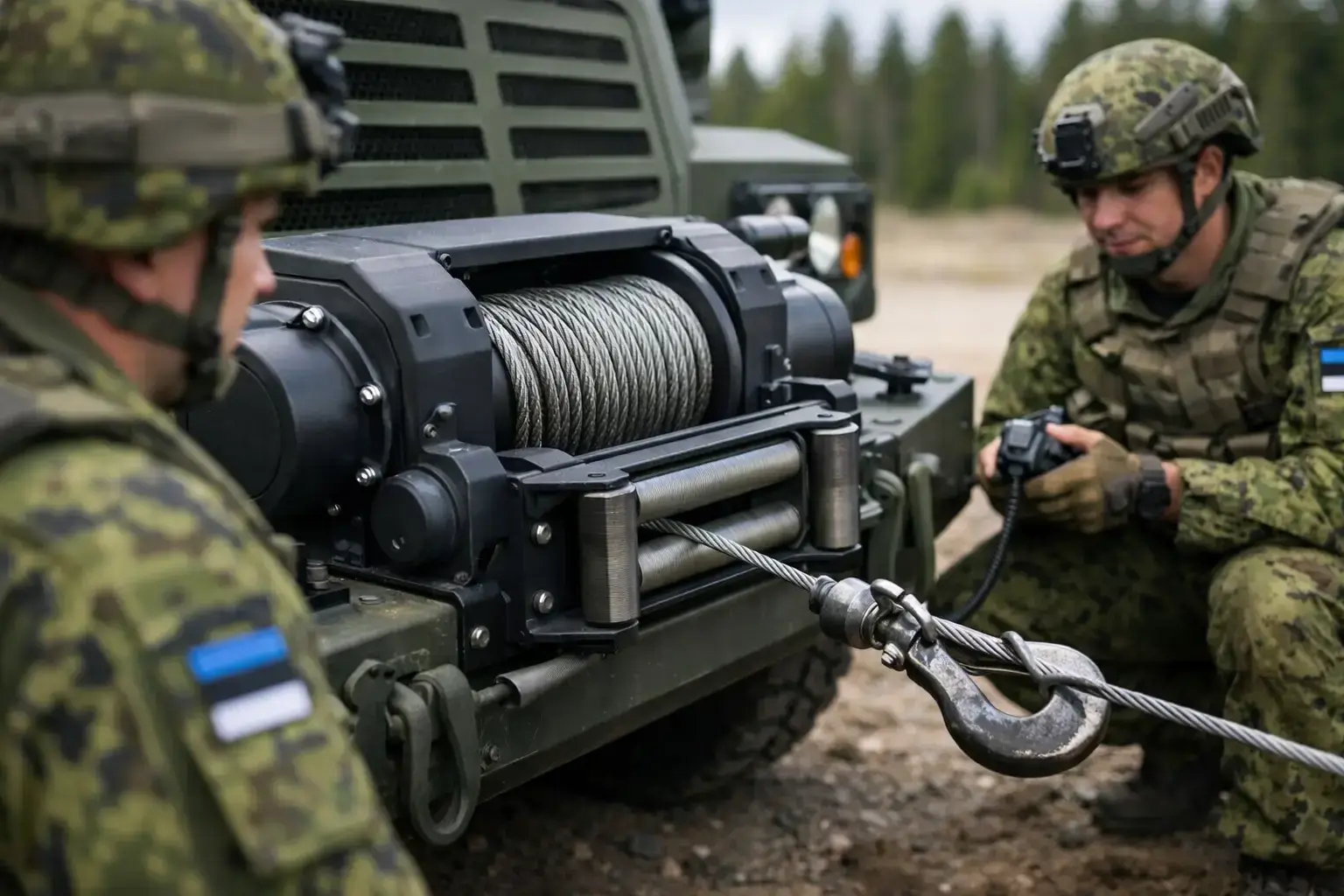
A recovery winch is only useful when it starts, holds, and pulls under load – not when conditions are easy. The key features and requirements of military winches are built around that reality: dependable recovery in mud, snow, water, steep terrain, darkness, and low temperatures. For field vehicles, support trucks, trailers, and off-road equipment, the right winch is a readiness tool, not an accessory.
Key Features and Requirements of Military Winches
A military-use winch must do more than advertise a high pulling number. It needs to match the vehicle, mounting system, power supply, cable type, duty cycle, and expected recovery conditions. A winch with impressive line pull can still be the wrong choice if its electrical system cannot support it, its rope is unsuitable for the environment, or the mounting points are not rated for the load.
The term “military grade” is also not a single technical standard. Requirements vary between vehicle platforms and missions. A light utility vehicle used for snow recovery has different needs than a heavy logistics truck operating on soft ground. The practical goal is the same: choose equipment that can work repeatedly when access to repairs, warm storage, or outside assistance is limited.
Pulling capacity with a real safety margin
Rated line pull is the first specification most buyers check, and it matters. As a baseline, a winch should generally be rated at least 1.5 times the vehicle’s gross operating weight. A 6,000-pound vehicle, for example, should not rely on a 6,000-pound winch for difficult recovery. Suction from mud, a steep slope, damaged tires, and an overloaded cargo area can increase resistance far beyond vehicle weight.
For demanding field use, additional capacity provides a useful margin. However, a larger winch also adds weight, draws more current, and requires a stronger mounting system. Bigger is not automatically better if it overloads the vehicle’s electrical system or pushes too much weight onto the front end.
Line pull also changes as rope layers build up on the drum. A winch produces its highest pull on the first layer of cable and less force as the drum fills. This is one reason a properly sized winch should not be selected at the absolute minimum rating.
Reliable power delivery and motor protection
Most vehicle recovery winches use a 12V or 24V DC electrical system. The winch must match the vehicle voltage exactly. A 24V system offers advantages for heavier applications because it can deliver high power with lower current draw, but it is not compatible with a standard 12V setup without the correct conversion and engineering.
A high-output battery, sound battery connections, heavy-gauge cables, and a charging system in good condition are all part of winch performance. A powerful motor cannot compensate for weak wiring, corroded terminals, or a battery that loses capacity in cold weather.
Thermal protection and a realistic duty cycle are equally important. Continuous hard pulling generates heat in the motor, solenoids, cables, and battery connections. Repeated recovery work may require planned cooling intervals. Operators should avoid long full-throttle pulls when a shorter pull, a snatch block, or a change in recovery angle can reduce the load.
Durability for Water, Dust, and Cold
Field equipment is exposed to more than rain. Fine dust enters controls and connectors, water reaches the drum and brake, and road salt attacks unprotected metal. Military-capable winches need sealed or well-protected electrical components, corrosion-resistant hardware, and housings designed to keep contamination away from critical parts.
Look closely at the control box, remote receiver, electrical connectors, motor seals, gearbox housing, and drum bearings. An advertised weatherproof rating is useful, but it should be supported by practical construction. Loose connector covers and exposed cable terminals become weak points in wet, freezing conditions.
Cold weather introduces separate demands. Grease can thicken, batteries lose available power, and moisture can freeze around the rope, fairlead, or drum. A winch intended for Nordic and Baltic winter conditions should use lubricants and seals suited to low temperatures, with controls that remain usable while wearing gloves. Regular inspection matters even more after operating in slush, salt, or deep snow.
Gear train, brake, and load control
The gear train determines how the motor’s power is converted into pulling force. Planetary gear systems are common because they are compact and fast, while worm gear systems can offer strong load-holding characteristics at the cost of speed and efficiency. The right design depends on vehicle space, required line speed, and the type of work expected.
An automatic load-holding brake is a core safety requirement. It must hold the vehicle or load securely when power is released. Brake location deserves attention, particularly with synthetic rope. Some brake designs create more heat in the drum, which can shorten synthetic rope life during sustained heavy pulls.
Free-spool engagement must also be dependable. If the clutch lever is difficult to operate with gloves, binds after mud exposure, or fails to engage fully, recovery can stop before it begins. Simple mechanical controls are often easier to inspect and service in the field.
Rope, Fairlead, and Recovery Hardware
Steel wire rope remains a practical choice for abrasive terrain, rough ground contact, and high-temperature conditions. It is durable and can tolerate abuse, but it is heavy, can develop sharp broken strands, and stores significant energy under load. Gloves are mandatory when handling it.
Synthetic rope is lighter, easier to handle, and safer to manage if it fails, especially when used with a recovery damper. It is often preferred for vehicle recovery, but it needs more care around sharp rocks, hot surfaces, abrasive sand, and prolonged UV exposure. Synthetic rope should be paired with a suitable aluminum hawse fairlead, while steel cable generally uses roller fairleads.
The recovery system is only as strong as its weakest component. Rated recovery points, shackles, soft shackles, tree savers, snatch blocks, and straps must all be selected for the expected load. Avoid attaching a winch line to a tow ball, bumper skin, suspension part, or any point not engineered for recovery. A failed anchor point can turn heavy hardware into a serious hazard.
Remote control and operator position
Wired remotes are simple, dependable, and free from battery or pairing issues. Wireless remotes allow the operator to stand farther from the vehicle, which can improve visibility and reduce exposure to the recovery path. For serious use, a winch with both options gives useful redundancy.
The operator should never stand in line with a loaded rope or directly beside a stressed recovery connection. The control lead must be long enough to allow a safe viewing position, and all bystanders should stay clear. Clear communication matters as much as the hardware when several people are involved in a pull.
Installation Requirements That Cannot Be Skipped
A winch needs a vehicle-specific or properly engineered mounting plate connected to structural points on the chassis. The mount must handle the winch’s rated pull, shock loading, and side-loading that may occur during angled recoveries. Cosmetic bumpers and light-duty brackets are not substitutes for a rated winch cradle.
Electrical cables should be routed away from heat, moving parts, and sharp edges. Use protective sleeving where needed, secure the cables against vibration, and install an accessible battery isolation switch. This makes maintenance safer and reduces the risk of electrical faults during storage or transport.
Before deployment, test the winch under light load, confirm correct drum rotation, inspect rope spooling, and verify that the brake holds. Rope should be wound evenly under tension after use. Loose, uneven layers can pinch during the next hard pull and damage both rope and drum.
Choosing the Right Winch for the Job
The best military-use winch is not necessarily the fastest or the highest-rated model on the page. Selection should begin with vehicle weight, gross load, mounting space, system voltage, and the terrain where recovery is likely to happen. A forestry support vehicle may prioritize water resistance and steel rope durability. A rapid-response 4×4 may benefit from lower weight, synthetic rope, and a compact mount. A heavy truck may require a 24V system and a winch designed for sustained, high-load work.
Plan the recovery system as one working unit: winch, mount, battery, cables, rope, fairlead, anchors, and recovery accessories. Inspect it before winter, after difficult recoveries, and whenever the vehicle has spent time in water, mud, or salt. When the ground gives way and there is no easy route out, disciplined setup and properly matched equipment are what get the vehicle moving again.
